



COMPOSER GEORGE TSONTAKIS
NAMED AN HONORARY TRUSTEE OF MAVERICK CONCERTS
For our November 2010 issue, ROLL Magazine asked Peter Aaron to interview composer George Tsontakis. Due to this recent honor, we’ve decided to post the article in its entirety:
The American Academy of Arts and Letters’ Charles Ives Living award is the world’s richest grant for a composer — $225,000, spread out over three years. In late 2006 the treasured prize went to one of modern music’s most treasured composers: George Tsontakis. Designed “to free a promising talent from the need to devote his or her time to any [salaried] employment other than music composition during the period of the award,” the honor has indeed resulted in several impressive new works from the Shokan resident and Bard College professor. But it also led to something else from the Grammy-nominated composer: he started playing the viola again.
“I’d stopped playing for a long time in order to compose, and then two years ago I started playing again to help me compose,” explains Tsontakis, who is also a formidable pianist. “I was reading a lot of chamber music because I was writing some. I also started playing with other musicians again, in [local chamber ensemble] Esopus Musicalia. It’s been a new phase of connectivity for me.”
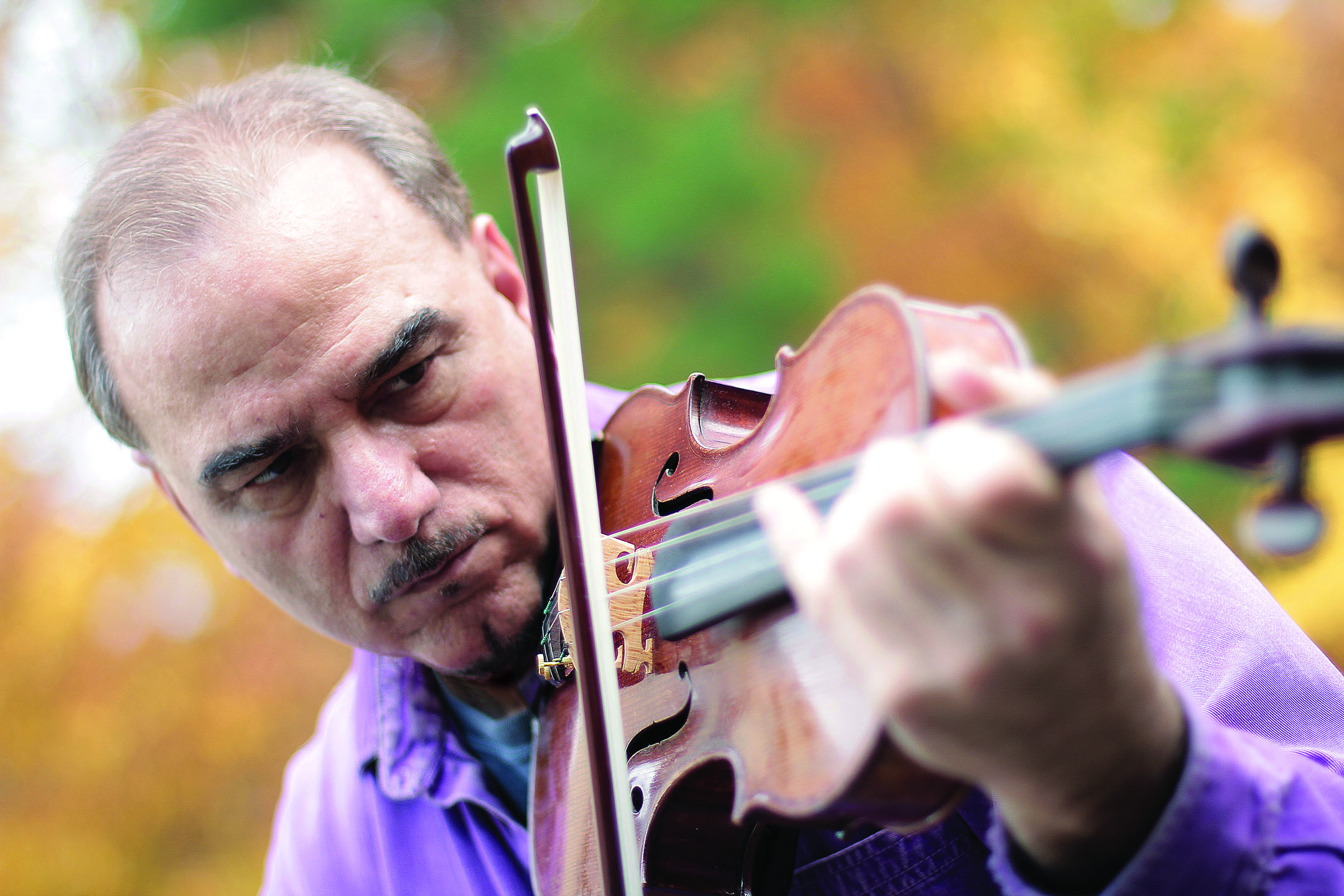
Tsontakis playing the viola, photo bt Matt Petricone
But while the connectivity is newly rediscovered, the creativity has been ongoing. Born in Astoria, Queens, Tsontakis began as an actor — he auditioned for the original Broadway production of Jesus Christ Superstar—before he enrolled at Julliard to study under the legendary Roger Sessions. Tsontakis still acts; currently, he’s starring in the Shandaken Theater Society’s production of Little Murders. Over time he developed an endlessly entrancing, accessibly modern approach rooted in the romantic impression of Debussy and the proto-serialism of Messiaen but also incorporating influences from before and after the two 20th-century French composers. Prior to the Ives Living award, Tsontakis’s music brought him a lifetime achievement award from the American Academy of Arts and Letters (1995), two Kennedy Center Friedheim awards (1989 and 1992), a coveted Grawemeyer Award (2005), and teaching positions at Bard College (since 2003) and the Aspen Music School (since 1976).
On November 14, in its first New York performance, the acclaimed Cypress String Quartet will present the city-wide premiere of Tsontakis’s fifth quartet, “In Memoriam; George Rochberg,” at the Tenri Cultural Institute. Named for the late composer, the brooding work parallels Rochberg’s path as a serialist turned neoromantic with appropriately elegiac, funereal passages and hints of atonality, all melting into spells of mournful frustration and bittersweet resignation. The event comes on the heels of a recent concert at Alice Tully Hall by the Riverside Symphony performing the five-part “Lakonica” (a piece premiered last April by the Los Angeles Chamber Orchestra with Tsontakis conducting).
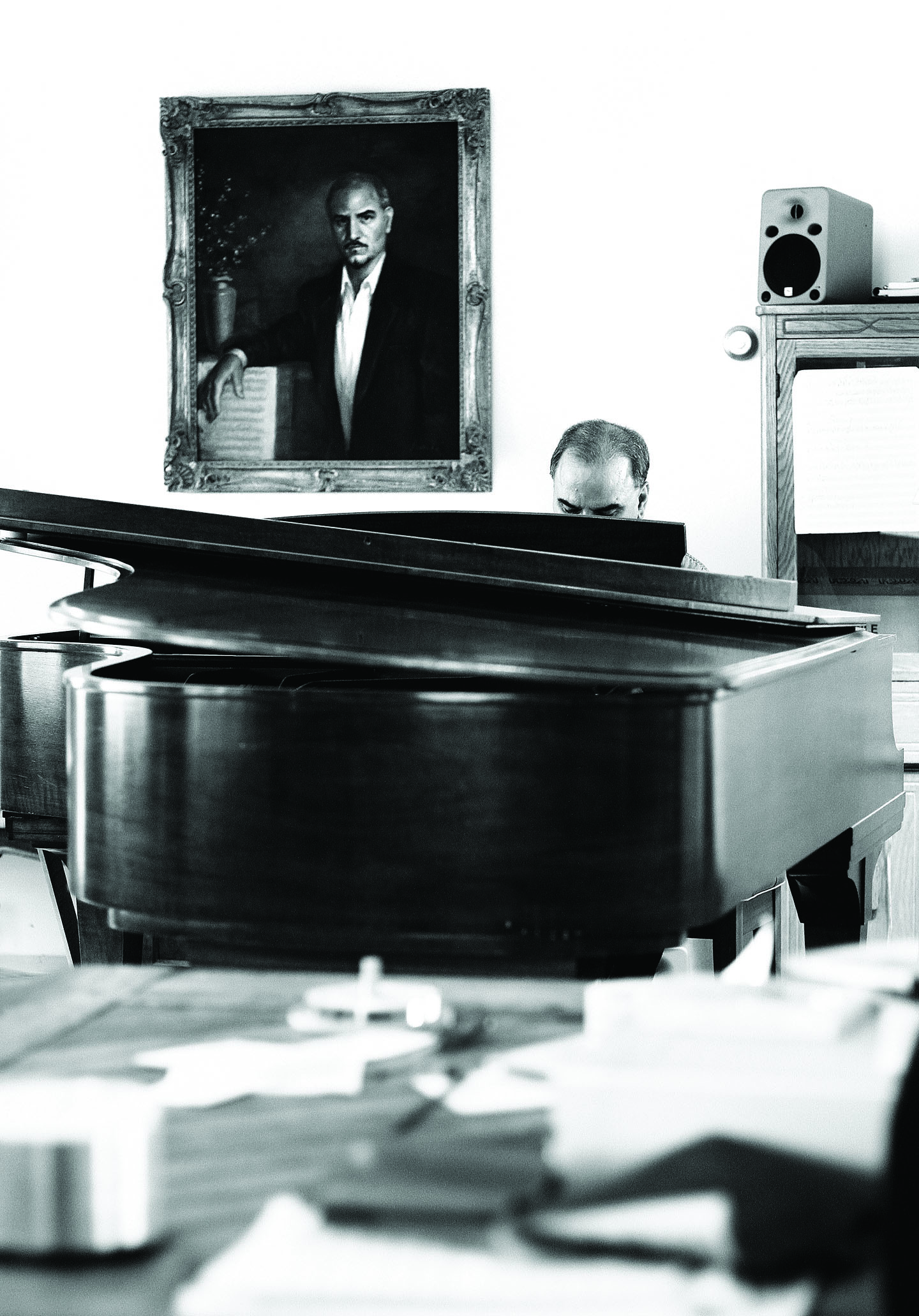
Tsontakis in his home studio, photo by Matt Petricone
And in addition to a revisiting of 1994’s “Let the River Be Unbroken” by the Albany Symphony at Carnegie Hall on May 10, next spring holds more world and regional unveilings. On May 5, Leon Botstein will lead the Bard Conservatory Orchestra in “Unforgettable,” a concerto for two violins (played by students chosen by competition) at Bard’s Fisher Center in Annandale-on-Hudson. On June 2, a major, still unnamed work for “Pierrot”-style ensemble will be performed by the Da Capo Chamber Players at New York’s Merkin Hall, and May 10 promises the introduction of another yet-to-be-named effort, a clarinet concerto to be performed by the Albany Symphony (with whom Tsontakis currently serves as composer-in-residence and new music advisor), at Rensselaer Polytechnic’s EMPAC Theater in Troy. Reflective of his own heritage, the composition draws on Greek folk music, but also incorporates Jewish klezmer, the specialty of Tsontakis’s long-time friend, the clarinetist David Krakauer. “George and I have reconnected artistically,” says Krakauer, who will perform on the date. “And the new concerto is all about exploring the music of our respective cultural backgrounds.”
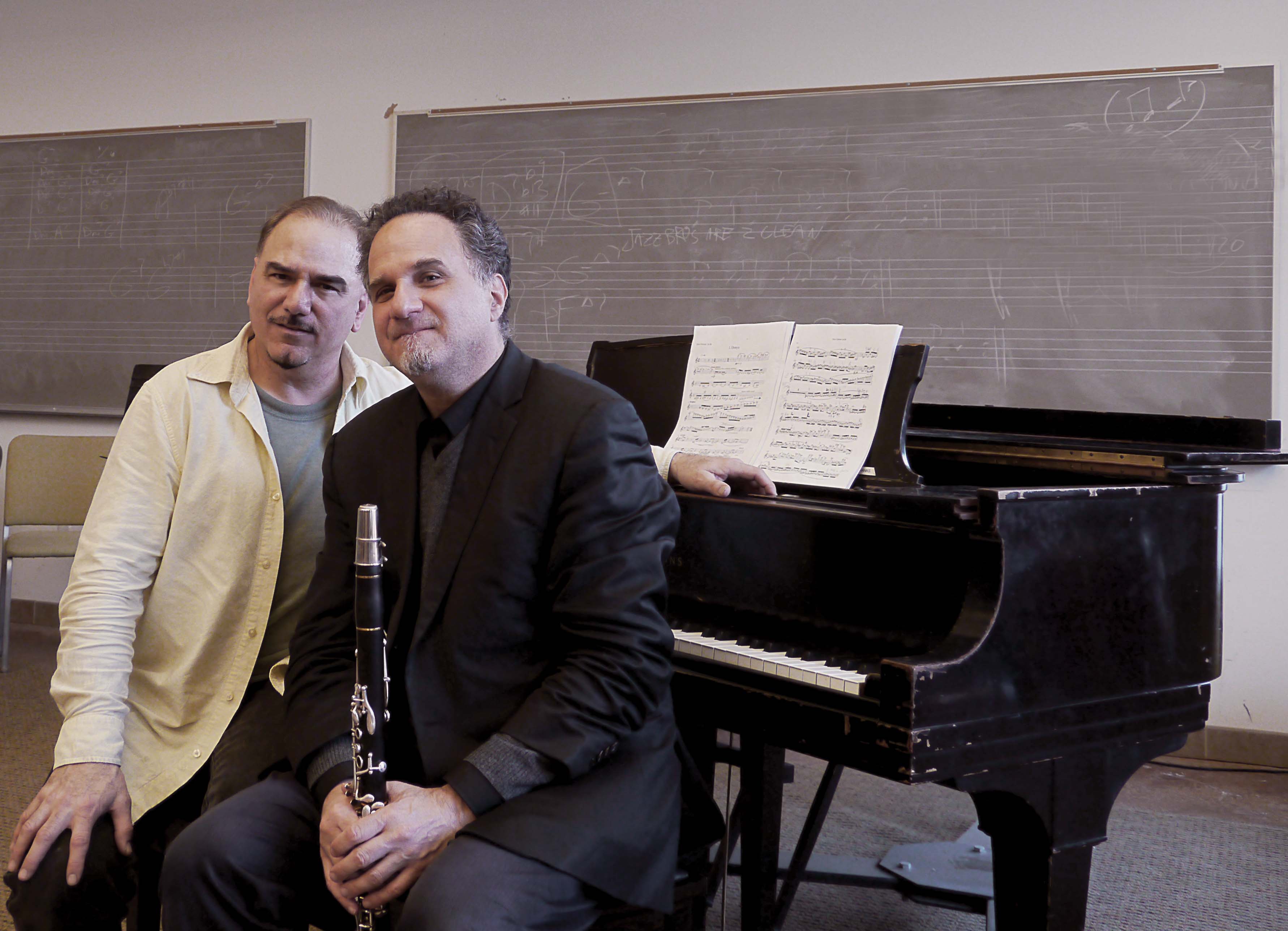
Tsontakis with clarinetist David Krakauer of the Klezmatics
Tsontakis’s New York/Albany/Hudson Valley itinerary — his “Hudson River Corridor Tour,” if you will — reflects another of his interests: keeping it regional. “I believe in provincialism at an age when one is supposed to ‘skip’ to the world right off the bat,” he says. “That is, you should work first with the talent and resources in your area and let what you achieve there bleed onto the larger scene. Perhaps this is becoming more and more of an arcane idea. But it seemed to work for Bach, who hardly, if ever, left Leipzig.” Underscoring his local commitment is his recently launched Highpoint Composition Seminar, a retreat for aspiring young composers that culminates with a local performance of their original works.
His reason for the increasingly local angle? “The Hudson Valley has been very good to me as an artist,” Tsontakis says. “So I want to give something back. My mantra is ‘There’s no place like home.’”
www.maverickconcerts.org