
Omega’s Eco-Machine™by Ross Rice
“It’s not easy….being Green”
- Kermit the Frog
Let’s face it. Mankind doesn’t do “waste” very well at all. Even setting aside the appalling amount of garbage and industrial waste created globally on a daily basis, we also consume an obscene amount of fresh water flushing away human excrement in large societies (cities), overwhelming any natural means of disposal. Subsequent water purification requires large amounts of chemicals and energy, while the fresh water sources become increasingly stressed and depleted. Surely, it’s possible for human communities to figure out ways to process waste harnessing natural processes, while somehow reclaiming the water. Nature does it without even thinking, “intelligent design” notwithstanding.
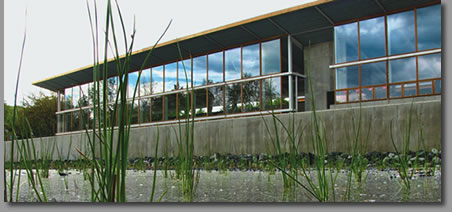
Fortunately, some forward-thinking people are tackling this wastewater issue head on. One of the recent results being the Omega Center for Sustainable Living (OCSL) in Rhinebeck: a “living building” that utilizes all natural components—bacteria, algae, fungi, snails, plant life—to recycle all wastewater on the Omega campus, processing approximately 5 million gallons per year. The building, with its constructed wetlands, greenhouse, and Eco-Machine™ is carbon neutral and self-sustaining thanks to geo-thermal systems and photovoltaic power generated on the roof. The project meets the extraordinarily rigorous criteria of LEED (the Leadership in Energy and Environmental Design rating system developed by the U.S. Green Building Council) Platinum status—the very best possible. And….it actually works.
It’s only natural that this project would be happening at the Omega Institute for Holistic Studies. Founded in 1977 by Stephan Rechtschaffen, and Elizabeth Lesser, Omega was envisioned as becoming a dynamic “university of life,” allowing participants a chance to briefly retreat from the material world, and explore issues of personal growth and wellness, science, spirituality, healing, and creativity. This was pioneering stuff in the late 70s, before the so-called 80s “New Age” movement, and it wasn’t long before Omega, which had been renting space for their summer workshops and programs, needed to find a full-time location.
They found just the place to suit their needs, just east of Rhinebeck. Camp Boiberik (at one time a popular camp for Yiddish youth) was a fully equipped campus sitting on 200 rolling acres. Since moving there in 1981, Omega has expanded yearly to over 100 buildings, including the Sanctuary, the Ram Dass Library, and now, the OCSL. The list of faculty who have taught and lectured there include Al Gore, Robert Kennedy Jr., Gloria Steinem, Shiva Rea, Mario Cuomo, Maya Angelou, Deepak Chopra, Jane Goodall, Mia Farrow, Michael Moore, Bobby McFerrin, Pete Seeger, Wayne Dyer, Sally Field, Arianna Huffington and many more extraordinary artists, healers, and teachers. At the same time, it’s quite a pleasant and serene Dutchess County location; part summer camp, part very hip college.
But one problem arose that required a more immediate solution: the campus septic system. In keeping with their core values of responsible low environmental impact and carbon footprint, Omega CEO Skip Backus sought alternative possibilities to just simply digging a new septic tank into another field. While researching those alternatives, he tapped into what would become an invaluable resource, a gentleman and genius who had been an Omega attendee, who knew a lot about water and natural resource planning: Dr. John Todd, of John Todd Ecological Design Inc.
When the book of humanity’s survival against its own technology is written, one of the book’s heroes will no doubt be Dr. Todd, who has put his considerable ingenuity toward finding workable solutions to the worldwide wastewater crisis. His Eco-Machine™ design has won several accolades, including the 2008 Buckminster Fuller Challenge Award, yearly awarded by a distinguished jury to “support the development and implementation of a strategy that has significant potential to solve humanity’s most pressing problems.” His goal: to make more available—“commercialize,” if you will—his discoveries of ecological processes “with an approach that is well suited for reuse applications in municipal and a variety of commercial wastewater environments, including commercial residential designs.”
After consulting with Dr. Todd, Skip had found the right solution to the wastewater problem that reflected Omega’s values. But, he also saw it as a spirited response to both the aforementioned LEED certification and the Living Building Challenge™, created by the Cascadia Region Green Building Council to challenge builders, owners, architects, engineers, and design professionals to build environmentally sound and self-sustaining buildings.

Anybody who has ever known or worked with Skip Backus will tell you, “The man gets things done”. With the concept in mind, he approached the architectural firm BNIM, one of the country's top sustainable design firms, and soon the vision became a fledgling reality, starting with a groundbreaking in 2007 featuring New York’s then-First Lady Silda Wall Spitzer.
The first order of business was to dig and install a series of equalization tanks under the parking lot, to collect and hold wastewater while handling any surge loads during high usage periods. Then, construction was underway, starting with a series of outdoor concrete cells, sunk underground with connective piping, for the constructed wetlands; the first stop for the wastewater coming from the holding tanks.
Skip explains that these wetlands, with its sequence of reeds, ferns, wildflowers, cattails and indigenous grasses is where the process starts to “digest the nitrogen and phosphorous, and the bacterial 'loading' of the wastewater. And it does that through the actual root systems of the plants, absorbing minerals and heavy metals, whatever is still moving through the waste stream.” A series of pumps guide the water through the outdoor chambers, powered by the solar panels on the roof.Then, the water reaches the interior of the main building, a primarily concrete, steel, and glass structure with large passive solar south-facing windows, and indoor holding pens for a variety of semi-tropical plant life, snails, fungi, and even fish. Once the water has completed the cycle and left the final concrete cell, it will have been purified to the point that it is safe to return to the water table—though not quite enough for safe human potability. Still, the water quality is monitored at all points of the process, and visitors can see for themselves the progress at each juncture.
The requirements for the LBC are pretty stringent. The project must be built only on previously developed land, with adequate distance from ecologically sensitive areas. Any virgin land developed must be matched by preserving the same acreage for 100 years. Energy needs must be renewable and met 100% on site. There is a tight “red list” of materials forbidden, mostly chemical-treated, and lumber must be certified to Forest Stewardship Council standards or from local salvage or on site, and most building materials from within 500 miles. All construction carbon footprints must be offset, and building material waste separated and diverted from landfills. Water must be from rainwater and closed-loop systems, with stormwater managed and integrated. Operable windows must be available to all, with fresh air and proper ventilation, and attention to pleasing aesthetics and educational opportunities, resulting in “a civilized environment.” So to speak.
But very important elements are: conservation and responsible use. Omega’s “water closets” will supply reminders of the impact of each flush. Skip: “One of the things about this project is reconnecting people to our impact (on our environment.) So when you think about waste…most of us flush it away and don’t ever think about it. That’s part of what we’re dealing with, this disconnect.” Omega also has the advantage of having a high quality vegetarian-based food menu that is not only healthier for the attendees, but for the waste system as well. New plans are presently underway to divert some of the processed water back into a separate water system to use for waste flushing, instead of fresh water.
Fast forward to July 2009. The OCSL is complete, and an anxious crowd—some enjoying popcorn and lemonade—awaits under a large white tent nearby to hear the speakers: Omega External Affairs Director Carla Goldstein, Skip, Dr. Todd, Quadricentennial Commission Director Tara Sullivan, environmental activist Majora Carter, and Omega co-founder Stephan Rechtschaffen. Each speaker touches on their personal experiences and feelings about the potential future, while explaining the need to be pro-active here and now, in the present. Though the problems before us with water and sustainability are real and immediate, they offer inspiration, solutions, and optimism for how to deal with them. Marshall Crenshaw plays a new song from his new CD—excellent—and the speakers gather to cut the ribbon, allowing everyone a peek at the Eco-Machine™.
It is a beautiful summer’s day. Yes, the Eco-Machine™ was not inexpensive to build, and will take several years before it can be seen to be “cost-effective” in raw dollars and cents. But perhaps others will see the potential of these eco-technologies and take up the LBC/LEED challenges, and as demand for the products increase, costs will decrease, industry will rise to meet the demand, and we will start to see a real change in how we approach water and how we use (or abuse and misuse) it.
[top]